 Illuvium
 staking links vault choices to separate Shard and revenue rewards
· updatedIlluvium staking uses V3 vaults on Base to connect ILV or ILV/ETH liquidity deposits with seasonal Shard points and conditional revenue distributions. Vault selection changes the Shard earning basis, while lock duration affects its multiplier. Revenue rewards follow separate funding conditions, so a growing points balance alone does not establish an ILV payout.
Vault Assets and Reward Eligibility
Each V3 vault accepts a different staking asset, which determines the deposit structure behind its reward position.
The ILV Vault
The ILV Vault accepts ILV tokens on Base. Holding ILV in a wallet leaves it outside that vault position; the staking transaction commits the selected amount. The deposit value and chosen lock duration supply inputs for the seasonal reward calculation.
The ILV/ETH Vault
The ILV/ETH Vault accepts Aerodrome liquidity-provider tokens, usually shortened to LP tokens. Creating those tokens requires equal dollar values of ILV and ETH in the documented Base pool. The LP tokens represent the combined liquidity position; staking them creates the V3 deposit. The published Shard rate applies per dollar of the staked position, including both sides of that liquidity.
Why Do V3 Shards Differ From Revenue Rewards?
V3 Shards are off-chain seasonal loyalty points, while Revenue Distribution pays ILV from protocol revenue when its funding conditions permit distribution. Points contribute to seasonal leaderboards and reward allocation. A Shard balance measures participation under a season's rules; it does not itself state how much ILV a wallet can claim. A points rate cannot establish an annual percentage yield without a defined reward value.
Arena leaderboard prizes and Zero Land rewards have their own participation rules. Owning a game asset or receiving a game prize therefore does not establish a staking position, even when those activities belong to the same franchise.
The Revenue Gate Behind RevDis
RevDis ties an ILV distribution to accumulated protocol revenue and the Safety Pool's funding state.
The Protocol Revenue Threshold
The November 2025 V3 terms set the revenue trigger in ETH. The published V3 rule requires accumulated revenue above 150 ETH and a fully funded Safety Pool before Revenue Distribution occurs. The 150 ETH figure describes protocol revenue, not a minimum personal deposit. Distributions pay ILV, so the trigger's unit differs from the reward asset.
Safety Pool Priority
The Safety Pool creates a funding dependency before revenue can reach stakers. A deposit's duration and growing Shard balance cannot establish whether that pool has reached its required state. Revenue from games, merchandise and other protocol activities supplies this system's underlying funding.
Lock Duration and the Launch OG Boost
V3 uses lock duration for its position multiplier and introduced a separate, temporary bonus for legacy staking history.
The Lock Multiplier
The documented lock range runs from 30 to 365 days, with longer commitments reaching a 2x Shard multiplier. The chosen lock multiplier stays fixed for that lock period. This fixes one input in the calculation; it does not freeze weekly emissions or a season's reward configuration.
The Expired Launch Incentive
OG Boost recognized weighted V1/V2 staking history on Ethereum. Its launch terms allowed a tenure-based multiplier up to 2x for 120 days from V3's November 2025 launch. That original window has ended. During the applicable window, the lock multiplier and OG multiplier multiplied, subject to a combined 3x cap. Opening a new position does not restart the launch-based clock.
Weekly Emission Decay and Seasonal Boundaries
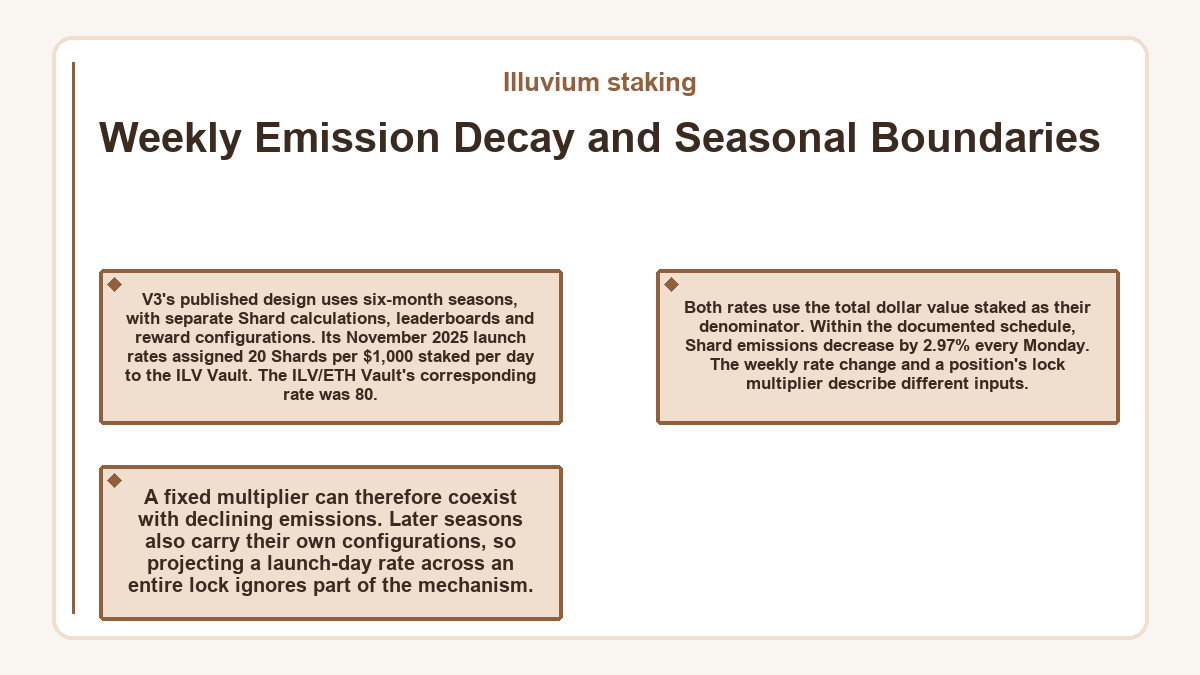
V3's published design uses six-month seasons, with separate Shard calculations, leaderboards and reward configurations. Its November 2025 launch rates assigned 20 Shards per $1,000 staked per day to the ILV Vault. The ILV/ETH Vault's corresponding rate was 80. Both rates use the total dollar value staked as their denominator.
Within the documented schedule, Shard emissions decrease by 2.97% every Monday. The weekly rate change and a position's lock multiplier describe different inputs. A fixed multiplier can therefore coexist with declining emissions. Later seasons also carry their own configurations, so projecting a launch-day rate across an entire lock ignores part of the mechanism.
Equal Deposit Values Under the Launch Rates
How do identical deposit values translate into points across the two vaults? Consider a hypothetical total stake value of $1,246 under the documented V3 launch rates, before weekly decay and multipliers. The LP option contains $623 of ILV and $623 of ETH. The ILV-only option commits the full $1,246 to ILV.
The ILV base calculation is
1,246 / 1,000 * 20 = 24.92
Shards per day. The LP base calculation is
1,246 / 1,000 * 80 = 99.68
Shards per day. The two $623 components combine into the $1,246 total used for the LP calculation.
The LP allocation produces four times the base points in this comparison, while also representing exposure to both assets. These are launch-rate calculations for one baseline day, not today's accrued balances. A different emission epoch or multiplier changes the point totals.
Why Can Shard Balances Lag Confirmed Stakes?
The displayed Shard balance reflects the latest completed daily snapshot, so it can lag a newly confirmed V3 position. The V3 balance schedule updates Shards at 00:00 UTC each day. My Stakes identifies the deposited position, while the point balance reflects daily accounting. A position can consequently appear before the next Shard update incorporates its participation. That mismatch alone does not prove the stake failed.
Wallet authorization remains a separate state from staking. The documented interface distinguishes a spending-cap request from the staking transaction committing tokens. Approving a spending cap grants permission; it does not establish the deposit. A confirmed position and a completed daily calculation answer different questions about the same participation.
Base Funding and Available Entry Paths
V3 deposits require the staking asset on Base and ETH on Base for transaction fees. Bridging is relevant when funds begin elsewhere; assets already on Base do not need that transfer. The ILV bridge uses LayerZero to connect Ethereum with Base, while direct ILV purchase on Base supplies another entry path. The ILV/ETH route additionally needs liquidity creation before the LP stake. Keeping some ETH outside that liquidity allocation matters because subsequent approvals and staking also require network fees.
Capital Commitments Behind the Vault Choice
The ILV Vault leaves the committed capital exposed to ILV's market price. The LP Vault adds exposure to ETH and the risks of providing liquidity, including losses as the assets' relative prices change. Lock selection then determines the duration of the commitment, separately from that asset mix. The next decision is whether a single-token deposit or a liquidity position fits the capital and lock period you can commit.
Common questions about Illuvium staking
Do Retained V2 Positions Earn V3 Shards?
Retained V2 positions do not earn V3 Shards. The V3 transition rules made migration optional, allowing a V2 position to remain outside the Base vault system. Moving those same funds requires any applicable V2 lock to expire first. V3 points depend on a V3 stake, rather than Ethereum staking history alone.
Which Linked Wallet Determined the Launch OG Tier?
The launch OG system selected the best tier from the highest staking tenure among linked Ethereum addresses. Linking several wallets did not add their tenures together to create a longer history. This rule concerned the temporary launch incentive, whose 120-day window ran from V3 launch; linking another address does not start a fresh bonus window.
Does an OG Badge Add a Separate Reward Multiplier?
OG badges are cosmetic and do not add a separate multiplier. The launch reward calculation used qualifying staking tenure to determine the OG Boost. Diamond, Gold, Silver and Bronze badges reflected tenure tiers, rather than supplying another bonus on top. The original OG Boost was temporary, so a badge does not establish continuing eligibility for that launch incentive.
How Quickly Can a V3 Staking Transaction Confirm?
V3's published estimate is 5-15 minutes for staking transaction confirmation. This estimate concerns the staking transaction, rather than every bridge transfer needed to prepare funds, and does not impose a fixed completion deadline. Deposit confirmation and daily Shard accounting also run on different schedules. A transaction confirmation does not promise an immediate update to the seasonal points balance.
What Did Season 1'S 15% Allocation Represent?
Season 1's launch allocation represented 15% of the total Shard Supply. That figure described the season's allocation, not a 15% return on each wallet's deposited assets. Individual participation followed the seasonal points calculations. The allocation also did not establish a fixed conversion between Shards, ILV and dollars.
Are V3 Staking Shards ERC-1155 Game Tokens?
V3 staking Shards are off-chain loyalty points, not ERC-1155 tokens. The Immutable zkEVM collection migration covered separate game assets, including items also called Shards. A shared name does not make game inventory and seasonal staking points interchangeable balances.